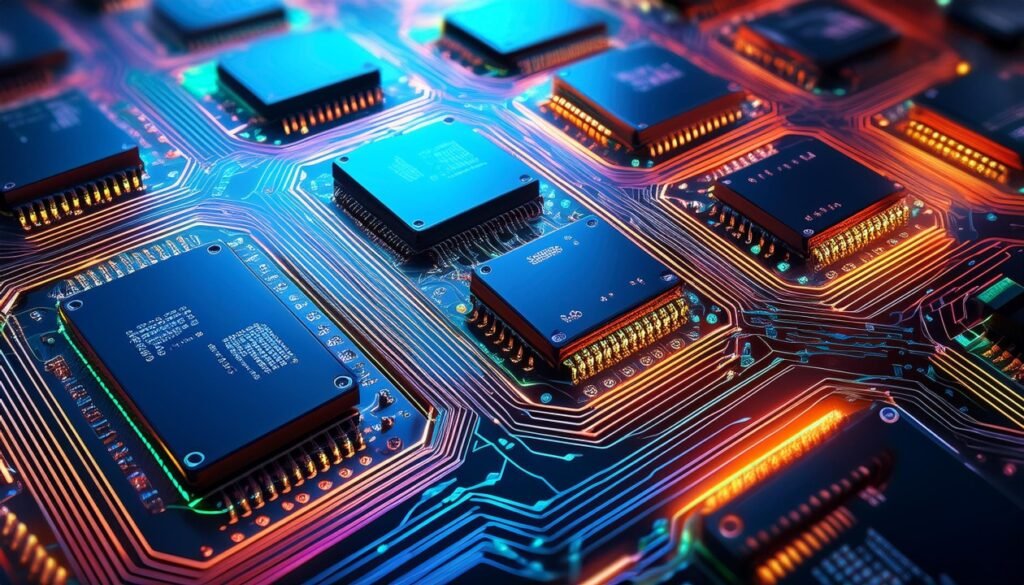
Very Large Scale Integration (VLSI) is the process of designing and manufacturing integrated circuits (ICs) by integrating millions or even billions of transistors onto a single semiconductor chip. It is the foundation of modern electronic devices, enabling compact, high-performance, and energy-efficient systems used in computers, smartphones, communication devices, and embedded systems.
Core Components
Digital Circuit Design: Designing logic circuits, processors, memory units, and digital systems using hardware description languages (HDLs) such as Verilog and VHDL.
Analog & Mixed-Signal Design: Developing analog circuits such as amplifiers, oscillators, ADCs, DACs, and power management systems.
Semiconductor Fabrication: Manufacturing ICs using CMOS technology, photolithography, doping, etching, and other fabrication processes.
EDA (Electronic Design Automation) Tools: Software tools such as Cadence, Synopsys, and Mentor Graphics are used for circuit design, simulation, verification, and physical layout.
The VLSI Design Process
Specification & Planning: Define system requirements, functionality, performance, and power constraints.
RTL Design: Develop the circuit using Hardware Description Languages (HDLs) such as Verilog or VHDL.
Simulation & Verification: Test and verify the design to ensure correct functionality and identify design errors.
Synthesis & Physical Design: Convert RTL code into a gate-level netlist and perform placement, routing, and chip layout.
Fabrication & Testing: Manufacture the integrated circuit and perform functional, timing, and reliability testing before deployment.
Common Use Cases
Microprocessors & CPUs: Designing processors used in computers, laptops, and servers.
Mobile & Consumer Electronics: System-on-Chip (SoC) designs for smartphones, tablets, smartwatches, and gaming devices.
Memory Chips: Development of RAM, ROM, Flash memory, and cache memory.
Communication Systems: High-speed processors and signal-processing chips for 5G, Wi-Fi, and networking equipment.
Automotive Electronics: ICs for Advanced Driver Assistance Systems (ADAS), engine control units (ECUs), and autonomous vehicles.
Artificial Intelligence Hardware: AI accelerators, GPUs, TPUs, and specialized chips for machine learning and deep learning applications.